|
Read time: 11 min
|
Posted on:
Doctors don’t mind that you looked it up. They mind who makes the diagnosis.
Be honest. You Googled your symptoms before calling a doctor. Your doctor already knows how this goes: you describe what’s wrong, hesitate, then admit what you read online.
“They said, I know I shouldn’t, but I Googled it. This is what it says. Doc, what do you think?” says Dr. Robert Chandler, a family medicine physician who sees patients on DrHouse. He doesn’t answer with a lecture. “OK, and then we have a discussion.”
You have plenty of company. In a KFF poll conducted in early 2026, 32% of U.S. adults said they had turned to an AI chatbot for health information or advice in the past year. Among those who asked about a physical health problem, 58% said they later followed up with a doctor or other health care provider. The rest did not.
So we asked five DrHouse physicians what goes through their minds when a patient says “I Googled it.” They did not all agree.
Most of them expect it, and they have a fair idea of what you found.
“Dr. Google is always on call,” Dr. Marc Berzansky, a board-certified family physician in California, said when we asked whether patients diagnose themselves before a visit. “Yes, they all think they have the answer.”
The answer patients arrive with tends to lean one way. Dr. Christin Barry, an emergency medicine physician with more than 10 years of experience in New York City, says a search usually turns up the scariest option on the list.
“They’ve probably Googled it and found some usually rare, unlikely diagnosis as a worst case scenario,” she says, “and then I have to try and convince them, or make sure that it’s not that crazy diagnosis and probably more likely something much more common and treatable.”
Her own preference is plain. “I don’t really like Googling,” she says. “I think it’s better to talk to a professional who has more context to what your symptoms are.”
Dr. Ragan Brackett, who is board certified in family medicine and obesity medicine, hears a quieter version. She recalls a patient who doubted her assessment because she had looked the condition up and found a support group for it. Dr. Brackett wasn’t surprised. People are “gonna Google it,” she says. “They’re gonna AI it.” But a search, in her view, “doesn’t equate to medical school and having a doctorate behind your name.”
She thinks many patients hold one question back. The unasked question, she says, “tends to center on whether Google was right or not about their problem.” It is a fair thing to ask out loud.
Here the doctors split.
Dr. Chandler is the optimist. “I think it was worse years ago,” he says. “I think five years ago people would Google things and then you don’t know what you’re getting. You don’t know what to trust.” In his view, chatbots and AI summaries have improved the starting point. “I think artificial intelligence made it better. So now when you Google it, the first thing that comes up is getting better and patients are getting more educated.”
He doesn’t think the risk is gone. “But still, I think that is a risk and people know that,” he says. He also points out that some of what doctors use is no secret. Of the symptom checklist he runs through for strep throat, he says, “You could Google and ChatGPT all this.”
Dr. Barry is not persuaded. “I don’t really like AI for medical advice at this point,” she says. Even for physicians, she treats it as a brainstorming aid for the differential, the list of possible causes a doctor works through. “It could help you broaden your differential so you’re considering more things, but at the end of the day, it really can’t diagnose things. I don’t trust it to diagnose things at this point.”
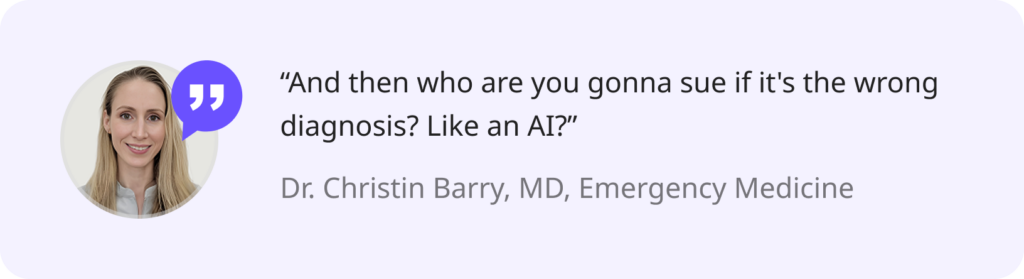
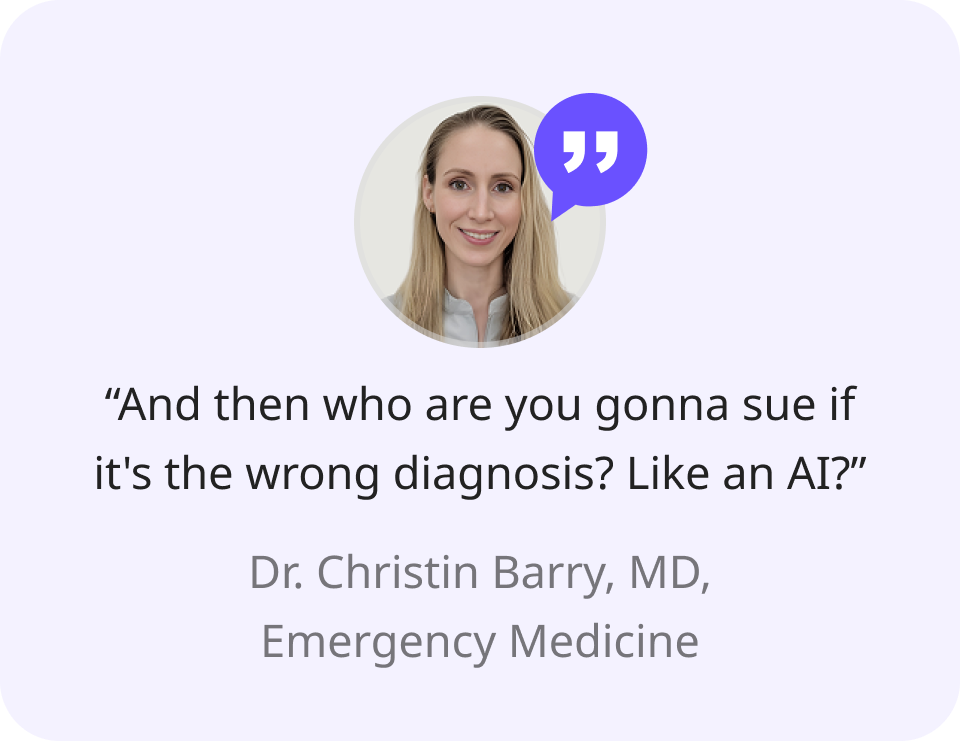
She has seen what AI does to paperwork, too. She reviews charts for one company where, she says, “the notes are like novels from these AI things,” even when the visit was for a simple upper respiratory infection. Then there is the matter of who answers for a mistake. “And then who are you gonna sue if it’s the wrong diagnosis? Like an AI?”
Dr. Vijaya Galic, a gynecologic oncologist and OB-GYN who treats a wide range of problems on DrHouse, is blunter about her own habits. “I wear a foil hat, I don’t do any of that,” she jokes. Her objection comes down to experience. She counts close to 1,200 cases as a resident, another 1,200 as a fellow and more than 6,000 patients on DrHouse since. “I can look at a patient, but ChatGPT can’t do that.”
The largest user study of its kind sides with the skeptics, though the chatbots’ medical knowledge was not the weak point.
Dr. Galic described research comparing AI users with people who searched the ordinary way. The AI users struggled, she says, because “they didn’t know how to ask the right question. They got led down the wrong garden path.”
Her summary is close to what a study published in Nature Medicine in February 2026 reported. Researchers led by the University of Oxford gave 1,298 people in the UK medical scenarios written by doctors. Each person had to work out what might be wrong and what to do about it. Some were assigned an AI chatbot. A control group used whatever they would normally use at home, such as a search engine.
| What Was Measured | Result |
|---|---|
| Chatbots alone, given the full scenario, naming a relevant condition | 94.9% of cases |
| People using a chatbot, naming a relevant condition | Fewer than 34.5% of cases |
| People using a chatbot, choosing the right course of action | Fewer than 44.2% of cases |
| People using a chatbot compared with people using their usual methods | No better |
The authors place the failure in the exchange between person and chatbot. In the conversations they reviewed, people often gave incomplete information. The chatbots sometimes gave misleading or inconsistent advice. Correct suggestions that did come up were sometimes left out of people’s final answers. A summary from Oxford adds that participants often did not know what information the chatbot needed.
One more finding applies to search and AI alike. Both groups tended to underestimate how serious the scenarios were.
Two cautions keep this from being the last word. The chatbots in the study were GPT-4o, Llama 3 and Command R+, and newer versions have since been released, which is Dr. Chandler’s point about the tools improving. And people will use them either way, so how you use them is the part to get right.
It goes wrong in three ways.
The first is the one Dr. Barry sees most, the rare and frightening diagnosis that sends someone into a visit already convinced. The second is harder to spot because it feels like relief. Asked whether online advice could delay care, she says, “I haven’t specifically seen it myself, but I could see that happening if it misses a critical diagnosis and you don’t think it’s something serious.”
The third comes with a checkout button. Dr. Galic sees patients who have bought test kits and supplements promoted online, with results she considers meaningless. Her advice is short. “Don’t waste money on these things. There’s no data for them.”
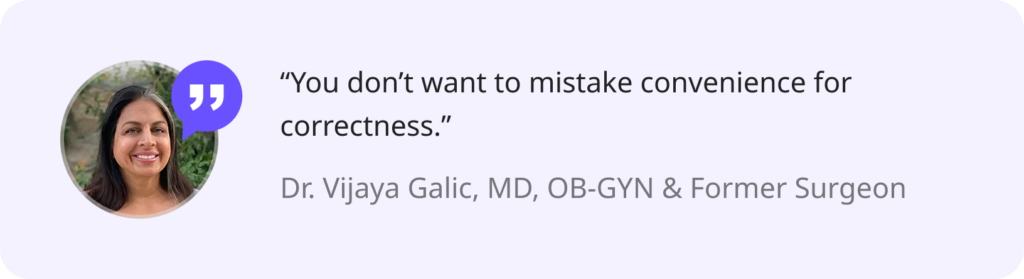
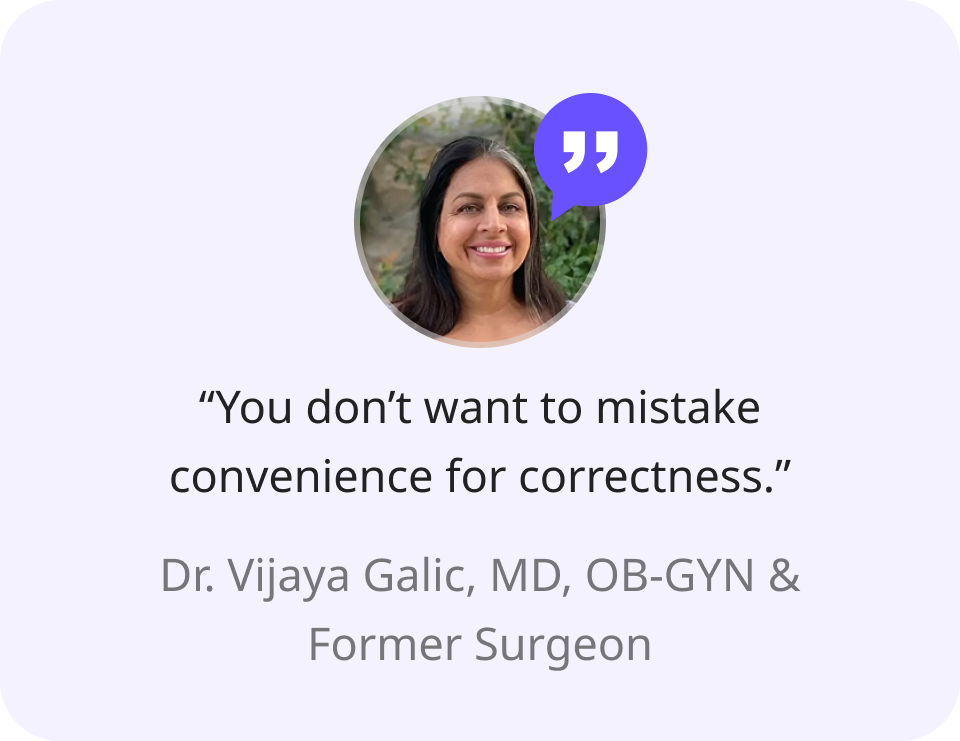
She has one line she says she would cross-stitch, and it fits this whole subject. “You don’t want to mistake convenience for correctness.”
Use them to get ready for the visit. These six habits make what you find useful to you and to the doctor.
| Search and AI Are Useful For | Leave to a Doctor |
|---|---|
| Explaining a medical term or a test name | Deciding what you have |
| Organizing your symptoms into a timeline | Ruling out something serious |
| Drafting questions for the visit | Choosing a prescription or a dose |
| Understanding a diagnosis you already have | Deciding whether a new symptom can wait |
If your search left you with more questions than answers, you can talk it through with a DrHouse doctor by video in minutes. Bring what you found.
No. Doctors expect it. The risk is treating a search result as a diagnosis. Searches tend to surface rare, worst-case conditions, so tell your doctor what you read and let them weigh it against your history and an exam.
It can list possibilities, but it cannot examine you, and it depends on what you tell it. In a 2026 Nature Medicine study, people using AI chatbots identified a relevant condition in fewer than 34.5% of cases, no better than people using their usual methods. DrHouse physician Dr. Christin Barry says she does not trust AI to make a diagnosis.
Some do, mostly for paperwork and for brainstorming. Dr. Barry says it can help a physician broaden the list of possible causes, but the reasoning and the final call stay with the doctor. She also notes that AI-written visit notes can run far longer than the visit needed.
Yes. It saves time and it tells the doctor what you are worried about. Dr. Robert Chandler says his patients often open with what a search told them, “and then we have a discussion.”
Skip it for anything that could be an emergency. Chest pain or pressure, trouble breathing, signs of a stroke, severe bleeding or a sudden change in alertness call for 911. In the Nature Medicine study, people tended to underestimate how serious a scenario was, with or without a chatbot.
Content on the DrHouse website is written by our medical content team and reviewed by qualified MDs, PhDs, NPs, and PharmDs. We follow strict content creation guidelines to ensure accurate medical information. However, this content is for informational purposes only and not a substitute for professional medical advice, diagnosis, or treatment. For more information read our medical disclaimer.
Always consult with your physician or other qualified health providers about medical concerns. Never disregard professional medical advice or delay seeking it based on what you read on this website.
If you are experiencing high fever (>103F/39.4C), shortness of breath, difficulty breathing, chest pain, heart palpitations, abnormal bruising, abnormal bleeding, extreme fatigue, dizziness, new weakness or paralysis, difficulty with speech, confusion, extreme pain in any body part, or inability to remain hydrated or keep down fluids or feel you may have any other life-threatening condition, please go to the emergency department or call 911 immediately.
Experience 24/7 complete care in one visit, including treatment, prescriptions, and delivery.


on your schedule
Skip the unnecessary waiting room,
see a board-certified clinician now.
Prescriptions as needed
Renew or get a new Rx.
On-demand virtual visits
See a physician 24/7.
24/7 care support
We are here to help you.

Download the DrHouse app.
Set up your free account in a minute.
Start a visit with an online doctor. Wait time is less than 15 minutes.
Get an Rx from your preferred pharmacy. Pick up a Rx nearby or get it delivered to you.
on your schedule
Skip the unnecessary waiting room, see a board-certified physician now.
Available in 50 states. Insurance accepted.