|
Read time: 13 min
|
Posted on:
A symptom that feels exactly like last time can have a different cause this time. Most sore throats are viral even if your last one was strep, and a repeat UTI can involve different bacteria. Doctors treat your history as a strong clue, then check the few details that separate one diagnosis from another.
Board-certified DrHouse physicians explain why a repeat symptom isn’t always a repeat diagnosis, and what to tell your doctor so you get the right treatment the first time.
You’ve had this before. You know how it starts, you know how it feels, and you’d like the same thing that fixed it last time.
Doctors hear that every day, and they take it seriously. You lived through the last episode. The doctor is hearing about it for the first time.
It is also the most common way patients get their own diagnosis wrong. When Dr. Robert Chandler, a board-certified family medicine physician who sees patients on DrHouse, was asked for the one piece of health advice he gives almost everyone, this is what he chose.
It is assuming that a symptom you have had before must have the same cause now.
“They feel that I felt something before so the next time I feel something similar it has to be the same thing,” Dr. Chandler says. “I have a sore throat, was strep throat, now it’s going to be strep throat again.” He sees his job as playing devil’s advocate. “This time could be different is what I have to tell people.”
He doesn’t blame anyone for it. “We as humans sometimes look for patterns and sometimes get tunnel vision,” he says, “and a third person or even a physician sometimes can take a step back and evaluate more objectively.” He admits he would do the same thing as a patient.
One of his examples is gout. “If you’ve had gout, you might have it again, but doesn’t mean every single joint pain you have is a gout flare. But that is the huge jump that everybody always does.”
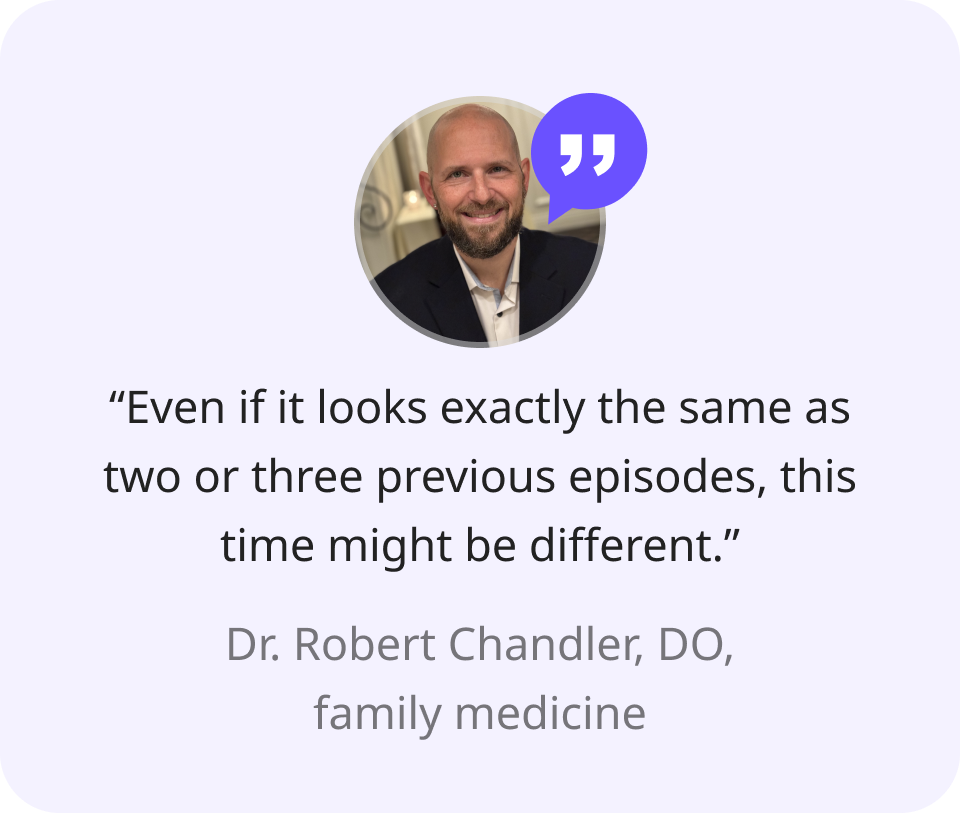
He says the same about patients who skip testing because a symptom looks familiar. “Even if it looks exactly the same as two or three previous episodes, this time might be different.”
Medicine has a name for the habit. Clinicians call it anchoring, which the federal Agency for Healthcare Research and Quality describes as sticking with a first impression even as new information becomes available. Doctors are trained to watch for it in themselves. Patients do it too, usually with the best evidence they have, which is their own memory.
No. Your history is one of the strongest clues a doctor has, and the doctors we interviewed lean on it constantly.
Dr. Vijaya Galic, a gynecologic oncologist and OB-GYN who sees a wide range of patients on DrHouse, treats every visit as a story to assemble. “The patient has a story, right? So you piece it all together.”
Take a red, swollen joint. If the patient has had gout before and just had beer and a seafood boil, she says, “the probability that this is gout is far higher.” If there is no history of gout and no risk factors, the same joint means something else to her. “That is a septic arthritis until proven otherwise.”
Septic arthritis is an infection inside a joint, and a delay in treatment can cause permanent joint damage. History moved the odds in both cases, and in neither case did it settle the question.
Doctors also take your word for what you feel. Dr. Sha-Barbara McDaniel, a board-certified OB-GYN with 33 years in practice, learned that from a pharmacist friend who said of her own doctor, “he can’t tell me how I feel.” Dr. McDaniel agrees. “We can’t tell you how you feel,” she says.
Dr. Ragan Brackett, who is board certified in family medicine and obesity medicine, says something similar when patients push back. “I know you know your body. I’m not here to refute that.”
So you own the symptom, and the cause still has to be checked. As Dr. Chandler tells patients with belly or joint pain, “Yes, you have the pain, but we don’t know what that is. We don’t know what that means yet.”
Usually a small one, and often one the patient didn’t think to mention. These are the examples DrHouse doctors gave us.
| The Symptom | The Assumption | The Detail a Doctor Checks |
| Sore throat | It’s strep again | Fever, a cough or runny nose, your age and a strep test |
| Burning when you urinate | Another UTI | Whether the burning is inside or on the skin, and what a urine culture grows |
| Stuffy nose and facial pressure | My sinus infection is back | How many days it has lasted, whether it itches and whether there is a fever |
| Red, swollen joint | A gout flare | Past gout, risk factors and fever |
| Bad period pain | That’s normal for me | Whether it is new and whether your usual pain reliever still works |
Most sore throats are caused by viruses. The CDC says only around 1 in 10 adults and 3 in 10 children with a sore throat have strep throat. A cough, a runny nose or a hoarse voice points toward a virus.
Dr. Chandler works through a symptom checklist, and he often has to tell someone who feels certain that he doesn’t think it is strep “even though it seems and feels like it could be.” A look at the throat isn’t enough on its own. “You can’t just visually diagnose it,” Dr. Galic says. Confirming strep takes a test.
Dr. McDaniel asks one question that splits this symptom in two. “Is the burning inside the body as the urine’s coming out? Or is it after the urine’s come out on the skin?”
Burning inside suggests a bladder infection. Burning on the skin suggests a rash or sores that the urine is irritating. “Those are two different treatments completely,” she says.
Time and itch do most of the sorting. Dr. Christin Barry, an emergency medicine physician with more than 10 years of experience, says allergies tend to bring “an itchy sensation in the throat or the nose” and can last for weeks. A virus is shorter and often comes with body aches.
Fever is the divider. “A true fever for us is over 100.4,” she says, and a true fever points away from allergies.
Time matters for sinus infections too. The CDC recommends seeing a doctor if symptoms last more than 10 days without improving, or get better and then worse again.
Dr. Brackett meets patients who insist they don’t have allergies. She asks whether they have ever used an allergy nasal spray or an antihistamine. When they say yes, she has her answer.
This is Dr. Chandler’s gout example and Dr. Galic’s warning together. A history of gout makes gout more likely. A hot, swollen joint with a fever, or one with no gout history behind it, needs to be seen in person quickly.
“Normal for me” can drift over the years. Dr. McDaniel asks whether the pain disrupts daily life and whether it has changed. “If it’s new for you, then that’s not normal,” she says. The same goes for a pain reliever that used to work and suddenly doesn’t.
Yes. UTIs show how a correct self-diagnosis can still leave the important question open.
Women who get repeat UTIs are usually right that they have one. A review in American Family Physician found that a patient’s suspicion of a UTI is more than 85% accurate at predicting a positive culture, which the authors note is more accurate than a urine dipstick.
Dr. Galic asks a different question. “Tell me what bacteria is in your bladder at the moment,” she says to patients who want the usual antibiotic. Nobody can answer it. “Yes, it’s probably bacteria in your bladder, but no, you do not know what it is. And that’s why we always do the culture.”

A culture shows which bacteria are growing and which antibiotics work against them. Guessing has a cost. Antimicrobial-resistant infections cause more than 2.8 million illnesses and more than 35,000 deaths a year in the United States. Dr. Galic sees the personal version in patients who were treated several times without anyone sending a culture.
Sometimes the test shows there was no infection at all. The same burning and urgency, she says, “can also be due to inflammatory disorders that mimic bacteria in the bladder.”
A bladder infection that isn’t treated properly can also travel. Most kidney infections start as a bladder infection, so fever, nausea or pain in the back or side along with urinary symptoms should be seen right away.
If you’ve had two UTIs in six months or three in a year, they count as recurrent. Ask your doctor about a prevention plan, not just another prescription.
A DrHouse doctor can order a urine culture at a lab near you, start treatment when clinically appropriate and adjust it once the result is in.
Because the detail that changes everything often arrives last.
Dr. McDaniel says that after 33 years she usually knows what is going on within the first few sentences. She jokes about it with patients, borrowing a movie line. “You had me at painful urination.”
She lets them finish anyway. “Every blue moon, someone might throw something different in that they didn’t say at the beginning,” she says. “So it’s almost like a Sherlock Holmes. They threw that last clue in at the end.”
Dr. Brackett describes the same discipline from the urgent care side. Most cases follow a pattern, and that is where the risk hides. “Most things look the same, but you’re looking for the one thing that is not the same,” she says.

Bring it, along with the details that let a doctor test it. Before your visit, fill this in:
Each line matters. A strep diagnosis backed by a positive test carries more weight than one made by feel. Dr. Galic asks about antibiotics that failed, because that narrows the next choice. And her best-prepared patients show up with last month’s culture report, which she uses to choose the antibiotic.
Don’t restart leftover antibiotics. The CDC says that when antibiotics aren’t needed, they won’t help, and their side effects could still cause harm.
The same logic applies to good news. A clean result describes one moment. Dr. Chandler hears from patients who had blood work once and assume they never need it again. “It could have changed,” he says.
A DrHouse doctor can go through your history and past results with you over video and order the right test if one is needed.
Sometimes, but not on history alone. A doctor needs to confirm that the cause is the same, and for infections that can mean a test or a culture. If the diagnosis holds, treatment is prescribed when clinically appropriate.
Itch and fever are the best clues. Allergies tend to cause an itchy nose or throat and can last for weeks, says Dr. Christin Barry, an emergency medicine physician. A true fever, over 100.4°F, points away from allergies. The CDC recommends seeing a doctor if sinus symptoms last more than 10 days without improving or get worse after starting to improve.
The questions test whether this episode matches the last one. Dr. Sha-Barbara McDaniel, an OB-GYN with 33 years of experience, says a patient occasionally adds a detail at the end that changes the whole picture. That is why she listens to the full story even when she is fairly sure.
Go back and say that the treatment didn’t hold. When an antibiotic fails, Dr. Vijaya Galic’s first question is whether the infection was bacterial in the first place. A culture can answer that and show which medication will work.
When it arrives with something it didn’t have before. A swollen joint with a fever, or urinary symptoms with fever and back pain, need in-person care right away. Call 911 for chest pain, trouble breathing or sudden confusion.
Content on the DrHouse website is written by our medical content team and reviewed by qualified MDs, PhDs, NPs, and PharmDs. We follow strict content creation guidelines to ensure accurate medical information. However, this content is for informational purposes only and not a substitute for professional medical advice, diagnosis, or treatment. For more information read our medical disclaimer.
Always consult with your physician or other qualified health providers about medical concerns. Never disregard professional medical advice or delay seeking it based on what you read on this website.
If you are experiencing high fever (>103F/39.4C), shortness of breath, difficulty breathing, chest pain, heart palpitations, abnormal bruising, abnormal bleeding, extreme fatigue, dizziness, new weakness or paralysis, difficulty with speech, confusion, extreme pain in any body part, or inability to remain hydrated or keep down fluids or feel you may have any other life-threatening condition, please go to the emergency department or call 911 immediately.
Experience 24/7 complete care in one visit, including treatment, prescriptions, and delivery.


on your schedule
Skip the unnecessary waiting room,
see a board-certified clinician now.

Prescriptions as needed
Renew or get a new Rx.
On-demand virtual visits
See a physician 24/7.
24/7 care support
We are here to help you.

Download the DrHouse app.
Set up your free account in a minute.
Start a visit with an online doctor. Wait time is less than 15 minutes.
Get an Rx from your preferred pharmacy. Pick up a Rx nearby or get it delivered to you.

on your schedule
Skip the unnecessary waiting room, see a board-certified physician now.
Available in 50 states. Insurance accepted.